Free Printable Hockey Game Sheet (PDF) — And How to Keep Score Without Losing Track
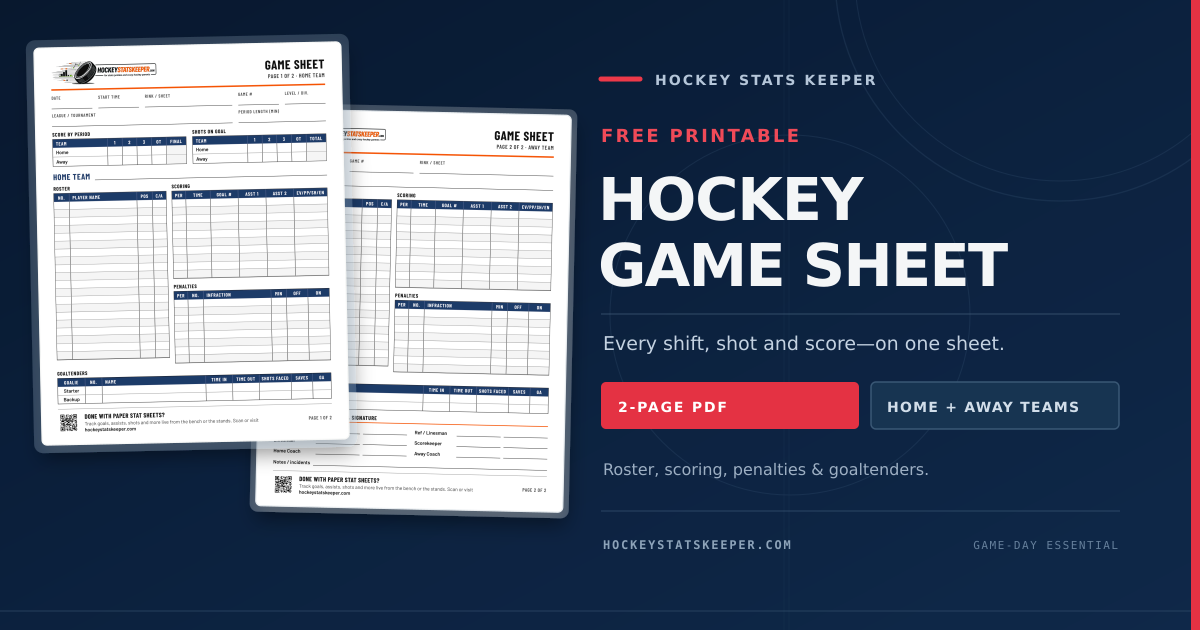
Quick answer: A hockey game sheet (or score sheet) is the official record of a hockey game. It captures the score and shots on goal by period, every goal with its time, scorer, assists, and strength (even strength, power play, shorthanded, or empty net), every penalty with its infraction and minutes, each goalie's shots faced, saves, and goals against, and the officials' and coaches' signatures. Our free printable game sheet is a two-page PDF — page 1 for the home team, page 2 for the away team.
Somebody always ends up at the scorer's table — a parent volunteer, a team manager, an off-ice official who's been doing it for twenty years. Whoever it is, they need a sheet that's laid out the way a hockey game actually happens. This page gives you one for free, plus a plain-English guide to filling it out — even if you've never kept score before.
Free Download
Printable Hockey Game Sheet (PDF)
Two pages, US Letter — home team on page 1, away team on page 2. Score by period, shots, scoring, penalties, goalie stats, and official signatures. Enter your email to unlock your free PDF.
Get the Free Game Sheet →What is a hockey game sheet?
A hockey game sheet is the official, written record of a single game. The scorekeeper fills it out in real time at the scorer's table, the referee and coaches sign it at the end, and it's what a league uses to post results, standings, player points, and suspensions.
You'll also hear it called a score sheet, scoresheet, game report, or official scoresheet. They all mean the same thing.
What's on our game sheet
Page 1 — Game info + Home team
Game header
- Date, Start Time, Rink / Sheet, Game #, Level / Div.
- League / Tournament
- Period Length (min) — needed to calculate goalie minutes
Score by period — Home and Away rows, columns for periods 1, 2, 3, OT, and Final.
Shots on goal — Home and Away rows, columns for 1, 2, 3, OT, and Total.
Home team section
| Section | Columns |
|---|---|
| Roster | No., Player Name, Pos, C/A |
| Scoring | Per, Time, Goal #, Asst 1, Asst 2, EV/PP/SH/EN |
| Penalties | Per, No., Infraction, Min, Off, On |
| Goaltenders | Goalie No., Name, Time In, Time Out, Shots Faced, Saves, GA — rows for Starter and Backup |
Page 2 — Away team + Officials
- Date, Game #, and Rink / Sheet repeated, so the pages can't get separated from each other
- Away team Roster, Scoring, Penalties, and Goaltenders — same layout as page 1
- Officials & Coaches — Name & Signature: Referee, Ref / Linesman, Linesman, Scorekeeper, Home Coach, Away Coach
- Notes / incidents — for game misconducts, injuries, protests, or anything the league needs to know
Giving each team its own full page means the scorekeeper never has to squeeze two teams' penalties into one cramped box — the most common source of score sheet mistakes.
How to keep score at a hockey game (step by step)
Before the game
- Fill in the header. Date, start time, rink, game number, division, league or tournament, and period length.
- Copy each team's roster from their lineup card. Jersey number, name, position, and C/A. (Need lineup cards? Grab our free printable hockey lineup card.)
- Enter both starting goalies with a Time In of the start of the game.
During the game
- Record every goal in the scoring team's Scoring section, the moment the referee reports it.
- Record every penalty in the penalized team's Penalties section.
- Track shots on goal for each team with tally marks, then total them at the end of each period.
- Log any goalie change — Time Out for the goalie leaving, Time In for the goalie entering.
After each period and at the end
- Fill in score and shots by period. Add them across for the Final and Total columns.
- Complete the goalie lines — shots faced, saves, and goals against for each goalie.
- Get signatures. Referee, linesmen, scorekeeper, and both head coaches sign page 2.
How to record a goal
Each goal is one row: period, game-clock time, scorer's number, first assist, second assist, and strength.
| Per | Time | Goal # | Asst 1 | Asst 2 | EV/PP/SH/EN |
|---|---|---|---|---|---|
| 2 | 11:42 | 17 | 4 | 22 | PP |
That row reads: "Second period, 11:42 on the clock, goal by #17, assisted by #4 and #22, on the power play." Leave Asst 2 (or both assists) blank for unassisted goals. Use the time as shown on the game clock — your league may count up or down, so stay consistent.
What do EV, PP, SH, and EN mean?
| Code | Meaning | When to use it |
|---|---|---|
| EV | Even strength | Both teams have the same number of skaters |
| PP | Power play | The scoring team had more skaters because of an opponent's penalty |
| SH | Shorthanded | The scoring team had fewer skaters because of its own penalty |
| EN | Empty net | The opposing goalie was pulled for an extra attacker |
How to record a penalty
| Per | No. | Infraction | Min | Off | On |
|---|---|---|---|---|---|
| 1 | 8 | Tripping | 2 | 6:15 | 4:15 |
- No. — the penalized player's jersey number
- Infraction — tripping, hooking, slashing, interference, roughing, and so on
- Min — penalty length (2 for a minor, 5 for a major, 10 for a misconduct)
- Off — game-clock time the penalty started
- On — game-clock time the player is eligible to return (on a count-down clock, a two-minute minor starting at 6:15 ends at 4:15)
If a power-play goal ends a minor penalty early, cross out the original On time and write the actual one.
How to fill in goalie stats
For each goalie, record Time In, Time Out, Shots Faced, Saves, and GA (goals against).
Quick check: Shots Faced − Saves = GA. If the numbers don't add up, recount before the coaches sign.
Those three numbers are all you need for the two stats every goalie parent asks about:
- Save percentage (SV%) = Saves ÷ Shots Faced
- Goals-against average (GAA) = (GA × full game length in minutes) ÷ minutes played
That's why Period Length is in the header — it's what turns Time In and Time Out into minutes played. For more on goalie math, see our guide to tracking hockey stats and goalie metrics.
Game sheet vs. lineup card: what's the difference?
| Lineup card | Game sheet | |
|---|---|---|
| Who fills it out | Each team (coach or manager) | The scorekeeper |
| When | Before the game | During and after the game |
| What it records | Who's dressed, numbers, positions, C/A, goalies, coaches | Score, shots, goals, assists, penalties, goalie stats, officials |
The lineup card tells the scorekeeper who's playing. The game sheet records what happened.
What a paper game sheet does well
It works in every rink, it never needs a charger, and when a goal or penalty is disputed, a signed sheet is the record everybody accepts. That's why paper score sheets are still everywhere — and why a clear, well-designed one is worth having.
Where the paper game sheet breaks down
1. The stats get stuck on paper
The sheet goes in a folder. Your team's points, assists, and goalie numbers never make it into a season total unless somebody retypes them.
2. Retyping is where errors happen
A 7 that looks like a 1, an assist credited to the wrong kid, a penalty in the wrong period — every manual copy adds mistakes.
3. Nobody can see it during the game
Parents in the stands and grandparents at home have no idea who scored until someone texts the group chat.
4. Season stats take hours
Turning fifteen game sheets into a leaderboard, a goalie save percentage, or a power-play total is a weekend project.
When you're ready to go beyond paper
Hockey Stats Keeper gives your team its own private stats website at yourteam.hockeystatskeeper.com. Enter goals, assists, and penalties live from your phone — from the bench or the stands — and leaderboards, goalie SV% and GAA, player profiles, and season-over-season comparisons update automatically. Every player and parent can check the stats themselves.
There's a 14-day free trial, so you can track a real game before paying anything.
Keep the paper sheet for the scorer's table — the league still wants it. For your own team's stats, see the best hockey stat tracker apps compared, or start with the free hockey stats spreadsheet template.
HOCKEY STATS KEEPER
Done with paper stat sheets?
Live goal tracking, automatic leaderboards, player profiles, and season history — all at yourteam.hockeystatskeeper.com.
Start Free Trial →Frequently Asked Questions
What is a hockey game sheet?
A hockey game sheet (also called a score sheet) is the official record of a hockey game. It records the score and shots by period, each goal with time, scorer, assists, and strength, each penalty with infraction and minutes, each goalie's shots faced, saves, and goals against, and the signatures of the officials and coaches.
Who fills out the game sheet in hockey?
The scorekeeper, sitting at the scorer's table, fills it out during the game. Coaches provide lineups beforehand, and the referee, linesmen, scorekeeper, and head coaches sign it after the game.
How do you record a goal on a hockey score sheet?
Write the period, the game-clock time, the scorer's jersey number, up to two assisting players' numbers, and the strength code: EV (even strength), PP (power play), SH (shorthanded), or EN (empty net).
What do EV, PP, SH, and EN mean on a hockey score sheet?
EV is an even-strength goal, PP is a power-play goal scored while the opponent had a player in the penalty box, SH is a shorthanded goal scored while the scoring team had a player in the box, and EN is a goal scored into an empty net after the opposing goalie was pulled.
What do "Off" and "On" mean in the penalty section?
"Off" is the game-clock time the penalty began and "On" is the time the penalized player is allowed back on the ice.
How do you calculate save percentage from a game sheet?
Divide saves by shots faced. A goalie who faced 30 shots and made 27 saves has a save percentage of .900.
Why does the game sheet have two pages?
Page 1 is for the home team and page 2 is for the away team, so each team gets full-size roster, scoring, penalty, and goalie sections. Page 2 also holds the officials' and coaches' signatures and an incident-notes box.
Is the game sheet really free?
Yes. It's a free printable PDF — we just ask for an email so we can send occasional tips for coaches, scorekeepers, and hockey parents. Your download is available immediately after submission. No credit card.
Ready to track your team’s hockey stats?
Hockey Stats Keeper gives your team a private website at yourteam.hockeystatskeeper.com with live goal tracking, leaderboards, player profiles, and more.
Start your free trial →