Free Printable Hockey Lineup Card (PDF) — And How to Fill It Out Before Puck Drop
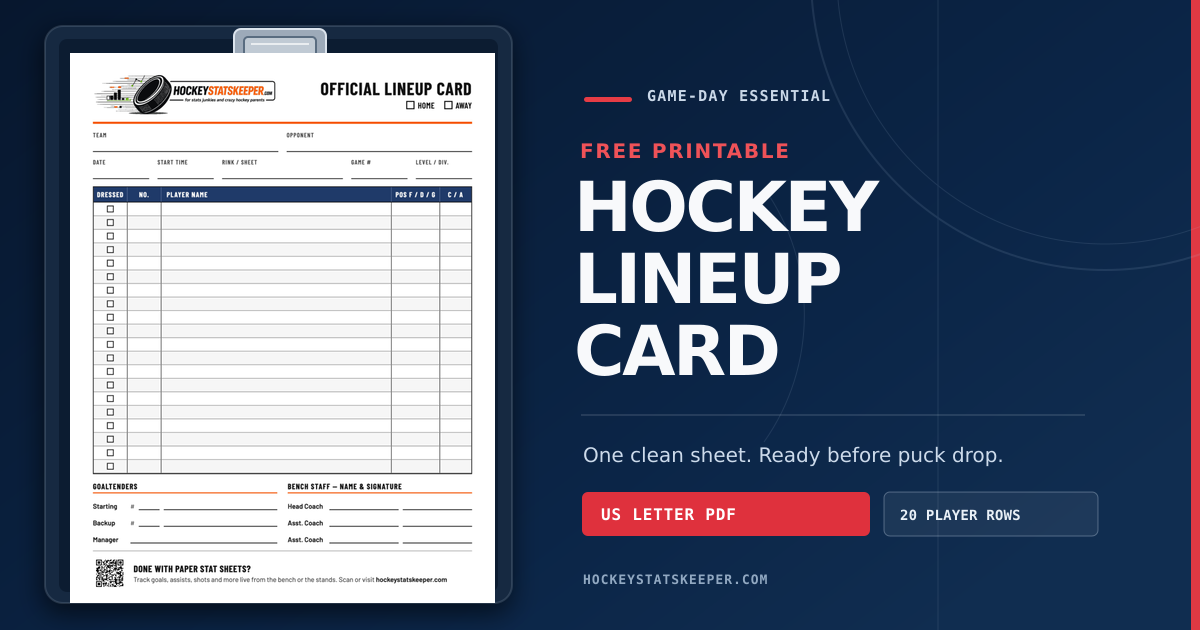
Quick answer: A hockey lineup card is the one-page form a team hands to the scorekeeper before a game. It lists every dressed player's jersey number, name, and position, marks the captain and alternates, names the starting and backup goalie, and carries the coaches' signatures. Our free printable lineup card (PDF, US Letter) has 20 player rows, a "dressed" checkbox for each, goalie and bench-staff sections, and room for date, rink, game number, and division.
Every game starts with the same scramble: someone at the scorer's table needs your lineup, the coach is taping sticks, and the team manager is digging through a bag for a pen and last week's crumpled sheet. A clean, consistent lineup card fixes that. This page gives you one for free — plus a short guide to filling it out so the scorekeeper gets it right the first time.
Free Download
Printable Hockey Lineup Card (PDF)
One page, US Letter. 20 player rows, positions, C/A, goalies, and bench staff signatures. Enter your email to unlock your free PDF.
Get the Free Lineup Card →What is a hockey lineup card?
A hockey lineup card (also called a lineup sheet or game roster card) is the official list of who is playing in a specific game. It's different from your season roster: the roster is everyone on the team, while the lineup card is who is dressed tonight, wearing which number, at which position.
The scorekeeper uses it to fill in the official game sheet, the referee may use it to check numbers and captains, and the coaches use it to confirm everyone eligible is accounted for. Many leagues and tournaments require one to be turned in before the opening faceoff — check your league's rules for its deadline and format.
What's on our lineup card
The card is a single page, organized top to bottom in the order you'll actually fill it out.
Game header
- Home / Away checkboxes
- Team and Opponent
- Date, Start Time, Rink / Sheet, Game #, and Level / Div.
Player table — 20 rows
| Column | What goes in it |
|---|---|
| Dressed | Check the box if the player is dressed and eligible for this game |
| No. | Jersey number the player is wearing tonight |
| Player Name | Full name, as it appears on the league roster |
| Pos F / D / G | Forward, Defense, or Goalie |
| C / A | Captain or Alternate captain — leave blank for everyone else |
Twenty rows is enough for a full lineup of 18 skaters and 2 goalies, which is the same size as an NHL game-day roster and covers most youth, high school, and adult league teams.
Goaltenders
- Starting goalie — number and name
- Backup goalie — number and name
- Manager — the team manager's name
Bench staff — name & signature
- Head Coach
- Asst. Coach (two lines)
How to fill out a hockey lineup card (step by step)
- Print a stack before the season. Keep five or six in the team bag so you're never writing a lineup on the back of a napkin.
- Fill in the header at home. Team, opponent, date, start time, rink, game number, and division can all be done the night before.
- Pre-write your full roster in the player table. Every player, number, and position — in jersey-number order, which is what most scorekeepers prefer.
- At the rink, check "Dressed" only for players who are actually suited up. A sick or injured player stays on the card but unchecked. This is the step that prevents most scoresheet errors.
- Mark C and A. One C, and typically up to two A's — follow your league's rule.
- Name your starting and backup goalie. Write them in the Goaltenders section even though they're also in the player table; scorekeepers look here first.
- Get coach signatures. Every coach on the bench prints and signs. Many leagues only allow listed, carded staff behind the bench.
- Hand it to the scorekeeper — and photograph it first. A phone photo is your backup if a stat or penalty is ever disputed.
Pro tip: If a player is wearing a different number than usual (borrowed jersey, lost sweater), write the number they're actually wearing tonight. Goals and penalties get recorded by number, so a mismatch sends stats to the wrong kid.
Lineup card vs. game sheet: what's the difference?
They work together, but they're not the same document.
| Lineup card | Game sheet | |
|---|---|---|
| Who fills it out | Each team (coach or manager) | The scorekeeper, at the table |
| When | Before the game | During the game |
| What it records | Who's dressed, numbers, positions, C/A, goalies, coaches | Score by period, shots, goals and assists, penalties, goalie stats, officials |
| Pages | One per team | Usually one page per team |
The lineup card feeds the game sheet. If you need a game sheet too, use a scorekeeper's game sheet designed to record the live action; it is a separate document from this printable card.
What a paper lineup card does well
It's fast, it's universal, and every rink in the world knows what to do with one. No app to install, no Wi-Fi in the rink basement, no dead phone battery. For the job of telling a scorekeeper who's playing, paper is hard to beat — which is exactly why we made a good one.
Where paper stops being enough
The lineup card does its job. The trouble starts with everything that happens after the puck drops:
1. The stats never leave the scorer's table
Your lineup card goes into the official game sheet, the game sheet goes into the league's folder, and your team never sees the details again. Who had the assists? Nobody remembers by Monday.
2. You rewrite the same roster every week
Same twenty names, same numbers, same positions — by hand, every game, all season.
3. Parents keep asking "who scored?"
The group chat fills up with questions the coach is too busy to answer.
4. Goalie usage gets lost
Who started, who played how many minutes, and how they did across a season is hard to reconstruct from a pile of lineup cards.
When you're ready to track more than the lineup
Hockey Stats Keeper gives your team its own private stats website at yourteam.hockeystatskeeper.com. Enter goals, assists, and penalties live from your phone during the game, and leaderboards, goalie save percentage and GAA, and player pages update automatically — so parents can check stats themselves instead of asking in the group chat.
There's a 14-day free trial, so you can track a real game before paying anything.
Keep the lineup card either way — the scorekeeper still needs it. For more, see our guide on how to track hockey stats, grab the free hockey stats spreadsheet template, or compare options in hockey stats spreadsheet vs. app.
Frequently Asked Questions
What is a lineup card in hockey?
A hockey lineup card is a one-page form listing the players dressed for a specific game — jersey number, name, and position — along with the captain and alternates, the starting and backup goalie, and the coaches' signatures. Teams hand it to the scorekeeper before the game so the official game sheet can be filled out.
How many players can you list on a hockey lineup card?
Our card has 20 player rows, enough for 18 skaters and 2 goalies. Maximum dressed-roster size varies by league, age group, and tournament, so check your league's rules.
Who fills out the hockey lineup card?
The team's coach or team manager fills it out, and the coaches sign it. It's then given to the scorekeeper, who copies the lineup onto the official game sheet.
When is the lineup card due?
Before the game starts — many leagues and tournaments ask for it before the opening faceoff or a set number of minutes before game time. Your league or tournament director sets the exact deadline.
What does C / A mean on a lineup card?
C marks the team captain and A marks alternate captains. Most leagues allow one captain and up to two alternates on the ice.
What does "Dressed" mean on a lineup card?
"Dressed" means the player is suited up and eligible to play in that game. Players who are on the roster but not playing (injured, sick, suspended, or absent) are left unchecked.
Is the lineup card really free?
Yes. It's a printable PDF — we just ask for an email so we can send occasional tips for coaches and hockey parents. No credit card.
Can I use it for youth, high school, and adult league hockey?
Yes. The card has no league-specific branding or rules, so it works for youth, high school, travel, house league, tournament, and adult (beer league) games.
Ready to track your team’s hockey stats?
Hockey Stats Keeper gives your team a private website at yourteam.hockeystatskeeper.com with live goal tracking, leaderboards, player profiles, and more.
Start your free trial →