Clarifying Icing and Offsides in Ice Hockey, for the Beginner
If you have ever watched a hockey game with someone new to the sport, you know the two rules they will ask about within the first ten minutes. The whistle blows, a faceoff happens somewhere on the ice, and they turn to you with a confused look. The first question is almost always about offsides. The second is almost always about icing.
Both rules sound complicated. Neither actually is — they just need a clear explanation. This guide walks through both, with the exceptions and the reasoning behind each, so the next time the whistle goes you will know exactly what just happened.
The Three Lines That Matter
Before either rule makes sense, picture the ice. A hockey rink has five lines that matter. Two goal lines at each end, where the nets sit. Two blue lines across the ice, dividing the rink into three zones. And one red line running through the center, splitting the rink in half.
The space between the two blue lines is the neutral zone. The space between your own goal line and your near blue line is your defensive zone. The space between the far blue line and the opponent's goal line is your attacking zone (also called the offensive zone).
Offsides and icing are both rules about which line a puck or a player crossed first.
Offsides: The Blue Line Rule
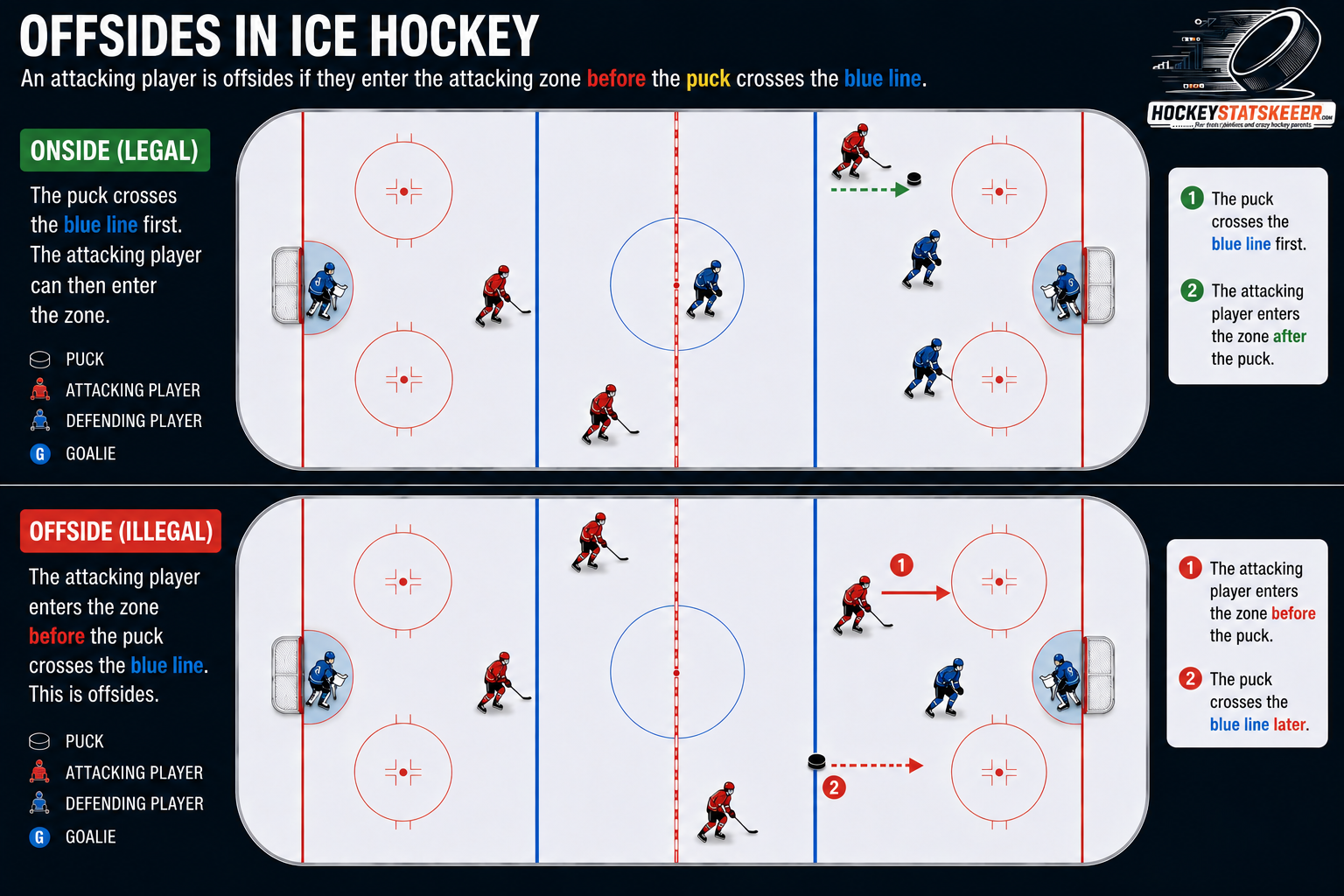
The rule, in one sentence: an attacking player cannot enter the opponent's zone before the puck does.
In practice, that means the puck has to cross the attacking blue line first. If a player from the attacking team crosses that blue line ahead of the puck, the play is offside. The linesman blows the whistle and the faceoff goes back to the neutral zone.
A few important details:
- The skate test. A player is only offside if both skates are fully across the blue line into the attacking zone before the puck arrives. If one skate is still on or behind the line, they are considered onside. This is why you will often see players with one skate dragging on the line, waiting for a pass — they are technically still onside.
- The puck and the player tied. If the puck and the player cross the blue line at the exact same moment, the player is onside. Offsides only happens when the player is clearly there first.
- Delayed offsides. Sometimes a player goes offside but their team doesn't actually play the puck — say, they overskated the line but the puck went the other way. Instead of stopping play immediately, the linesman raises an arm to signal a "delayed offside." If every attacking player exits the zone (back across the blue line) before the defending team touches the puck, play continues. This is called tagging up. The NHL added this rule in 2005 to keep the game flowing.
Why the rule exists. Without offsides, the smart play would be to leave one forward camping near the opponent's net all game waiting for a long pass — what hockey calls "cherry-picking." Offsides forces teams to enter the attacking zone together, which is what produces the structured, passing-and-cycling style of the modern game.
Icing: The Length-of-Ice Rule
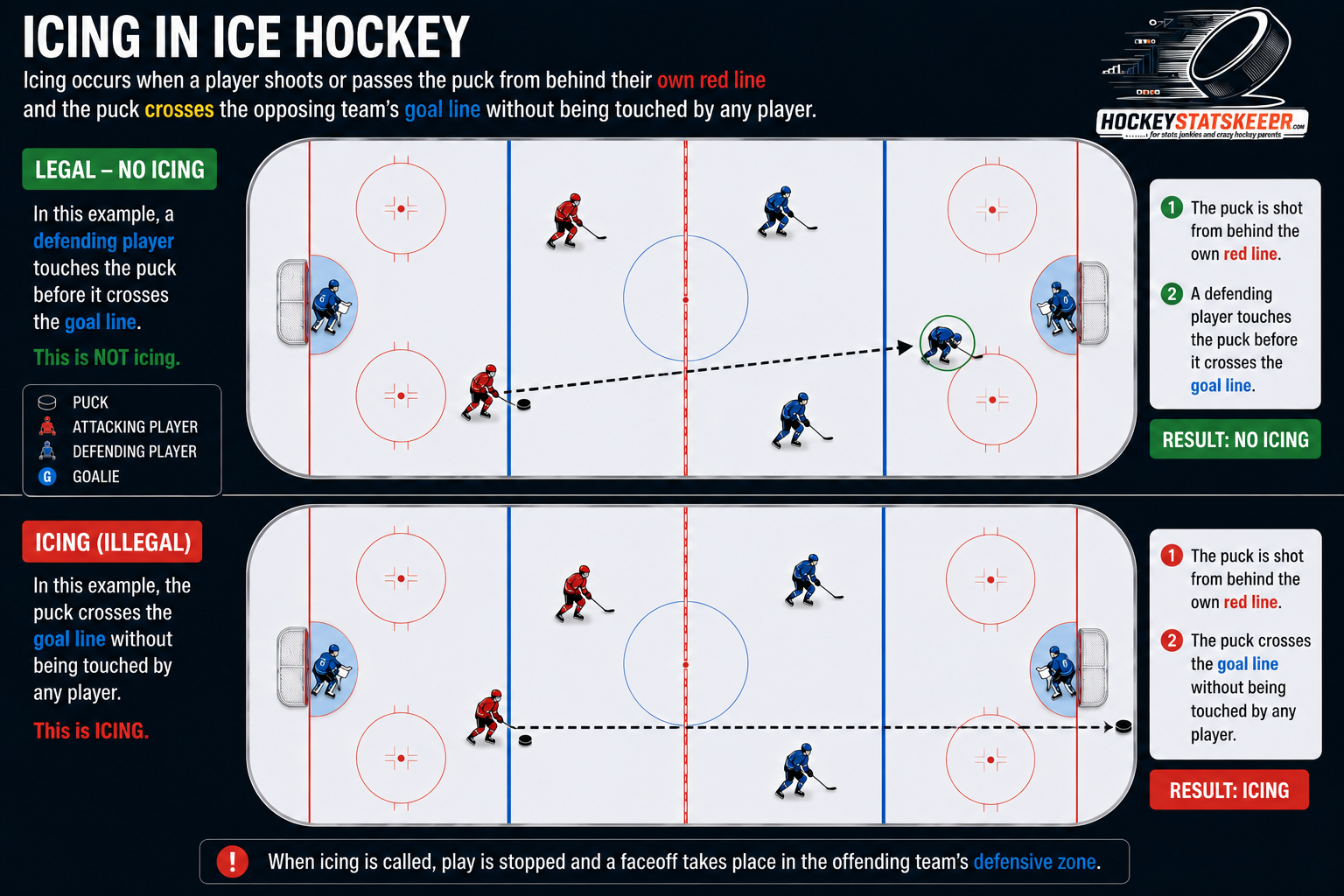
The rule, in one sentence: a player cannot shoot the puck from behind the center red line all the way past the opponent's goal line without anyone touching it.
For icing to be called, three things have to be true: the puck has to originate from behind the center red line, it has to cross the opposing team's goal line, and nobody on either team can touch it in between. If all three conditions are met, the linesman calls icing. The faceoff goes back to the defending team's end — and, importantly, the team that iced the puck is not allowed to change their players for the faceoff. They have to skate the same tired line back out, which is the real penalty for icing.
Touch, hybrid, and no-touch icing
There are three versions of how icing actually gets called, and they matter:
- Touch icing (older NHL, some junior and international play): the puck has to actually be touched by a defending player for icing to be called. This created dangerous foot races between defenders and attackers chasing the puck into the corner — and a number of serious injuries — which is why the NHL moved away from it.
- Hybrid icing (current NHL, since 2013): the linesman watches who would win the race to a "decision line" near the faceoff dots. If the defender would get there first, icing is called immediately, before the race gets dangerous. If the attacker would, play continues.
- Automatic / no-touch icing (most international hockey, IIHF): icing is called the instant the puck crosses the goal line, no race required. Cleanest and safest version of the rule.
Exceptions to icing
A few situations where the linesman waves the call off:
- The defending team is shorthanded (on a penalty kill). They are allowed to ice the puck without consequence — a critical defensive tool during a power play.
- The goalie plays the puck, or could have played it if they had chosen to.
- A defending player could have played the puck before it crossed the goal line.
- The puck deflects off any player, official, or the boards in a way that changes its path.
- The puck originates from inside the attacking zone — a player chipping it deep is not icing.
Why the rule exists. Without icing, the obvious tactic for a team protecting a lead would be to shoot the puck the full length of the ice every time they got it, killing time and forcing the other team to skate it all the way back. Icing makes that strategy expensive — you lose the faceoff in your own zone and you can't change your line.
A Mental Model for Both
If you only remember two questions, you can call either rule yourself:
- For offsides: Did an attacking player cross the blue line into the offensive zone before the puck did?
- For icing: Did the puck travel from behind the center red line, all the way across the opposing goal line, untouched?
If the answer is yes, the whistle blows. Everything else is exceptions.
Common Confusions
"Why is the linesman raising an arm but not blowing the whistle?" Delayed offside. The attacking team has a chance to clear the zone and reset before the call becomes official.
"The puck clearly crossed the goal line — why isn't that icing?" Most likely the team was shorthanded, the goalie played or could have played it, or a defender could have intercepted it. Icing requires the defense to have had no realistic chance.
"Can you be offside if a teammate passes to you from inside your own zone?" No. Offsides only happens at the attacking blue line. You can stand anywhere you want in your defensive zone or the neutral zone.
"My skate was on the blue line — is that offside?" No. Both skates have to be fully across the line into the attacking zone. On the line counts as onside.
"What about a player skating backwards across the blue line?" Same rule. Direction doesn't matter — only which side of the line both skates are on when the puck crosses.
Why These Two Rules Together Define Hockey
Offsides and icing are not arbitrary. Together, they do most of the work of shaping how hockey is played. Offsides forces teams to enter the attacking zone with the puck, as a coordinated unit, which is what makes hockey a passing-and-cycling game rather than a long-bomb game. Icing forces teams to play the puck out of their own zone under control instead of dumping it the length of the ice, which is what keeps the action sustained instead of stop-and-start.
Take either rule away and the sport collapses into something less interesting. Take both away and it's barely recognizable. Understanding why they exist is the difference between watching hockey and seeing it.
Beyond the Rules
Once these two rules click, almost everything else in a hockey game starts to make sense. The breakouts and zone entries are designed around offsides. The penalty kill and the chip-out are designed around icing. The way coaches deploy their best defensemen against the opponent's top line in the defensive zone — that, too, is downstream of these rules.
If you're coaching a team or tracking your own family's hockey life, Hockey Stats Keeper covers everything that actually gets tracked across a season — goals, assists, shots, save percentage, GAA, plus/minus, and twenty-nine penalty types — on a private team website at yourteam.hockeystatskeeper.com. Real-time stat entry during games, automatic leaderboards, season-over-season comparisons, and PDF game reports. Start your free trial.
Ready to track your team’s hockey stats?
Hockey Stats Keeper gives your team a private website at yourteam.hockeystatskeeper.com with live goal tracking, leaderboards, player profiles, and more.
Start your free trial →